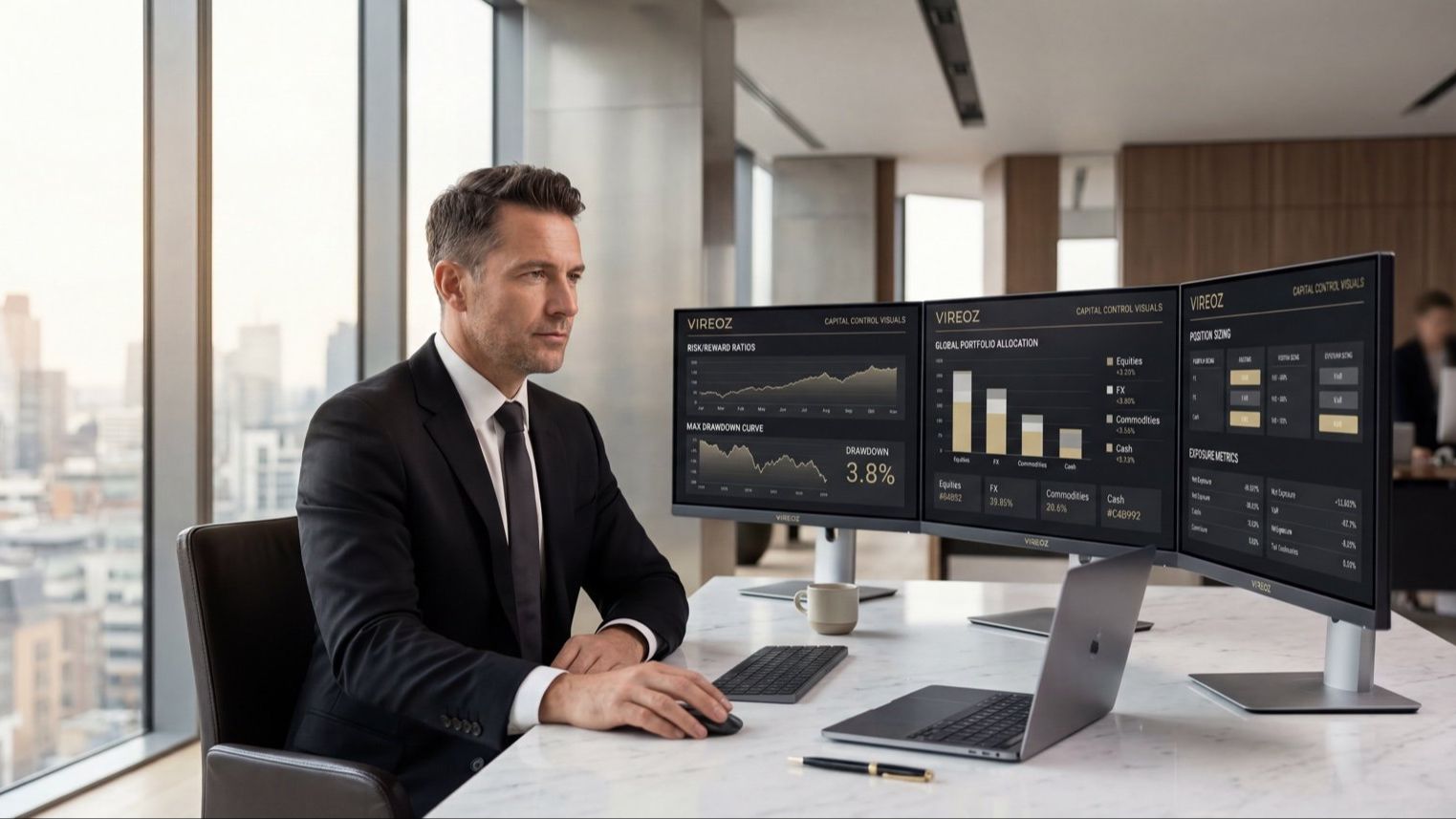
Capital Control: How Professional Traders Manage Risk and Exposure
Mar 22, 2026Introduction
In trading, the concept of risk is often misunderstood.
Most participants view risk as something to manage after entering a trade.
Professional traders understand that risk must be defined before any decision is made.
This distinction is critical.
At the highest level, trading is not built on prediction—it is built on capital control.
Without a structured approach to capital, even the most effective strategy will eventually fail.
At VIREOZ, risk is not treated as a secondary consideration.
It is engineered into a system we define as Capital Control—a disciplined framework designed to manage exposure, protect capital, and ensure long-term sustainability.
⸻
Capital Control Is the Foundation of Performance
Retail traders tend to focus on potential profit.
They ask:
• “How much can this trade make?”
• “What is the upside?”
Professional traders approach the market differently.
They ask:
• “How much capital is at risk?”
• “Is that risk acceptable within my system?”
This shift in thinking changes everything.
Profit is variable.
Capital risk is controllable.
The ability to control capital is what allows performance to compound over time.
Without it, even profitable strategies become unstable.
⸻
Defining Risk Before Execution
Every trade must begin with a clearly defined risk profile.
This includes:
• Maximum risk per trade
• Position size relative to total capital
• Stop loss placement based on structure, not emotion
• Total exposure across all active positions
These variables are not adjusted after entry.
They are determined before execution.
If risk cannot be clearly defined, the trade does not qualify.
This removes uncertainty and enforces discipline at the decision level—where professional trading begins.
⸻
Position Sizing and Capital Allocation
Position sizing is one of the most critical—and most overlooked—components of trading.
Without proper sizing, even a high-quality setup can lead to excessive losses.
Professional traders operate within strict allocation parameters:
• A fixed percentage of capital risked per trade
• Controlled exposure across correlated positions
• Adjustments based on volatility and market conditions
This ensures that no single trade has the ability to significantly damage the account.
Capital is not preserved by avoiding losses.
It is preserved by controlling their magnitude.
⸻
Managing Exposure Across Positions
Risk does not exist only at the individual trade level.
It exists across the entire portfolio.
Multiple positions can create compounded exposure, especially when trades are correlated.
For example:
• Taking multiple positions in similar market conditions
• Trading assets that move in the same direction
• Increasing exposure during high-volatility environments
Professional traders account for this by:
• Limiting total portfolio risk
• Reducing position size when multiple trades are active
• Avoiding redundant exposure
The objective is not to maximize activity.
It is to maintain control.
⸻
The Role of Drawdowns
Losses are an inevitable part of trading.
Even the most consistent traders experience drawdowns.
The difference lies in how those drawdowns are managed.
Without capital control:
• Losses compound rapidly
• Emotional decision-making increases
• Recovery becomes more difficult
With structured control:
• Drawdowns remain contained
• Recovery is achievable
• Confidence in the system is preserved
Professional traders do not attempt to eliminate losses.
They design systems that can withstand them.
⸻
Capital Control as a System, Not a Reaction
Most traders treat risk as something to react to.
They adjust after losses.
They reduce size after drawdowns.
They become cautious after mistakes.
This reactive approach creates inconsistency.
At VIREOZ, capital control is integrated into a predefined system.
It is applied consistently:
• Before trades
• During execution
• Across all market conditions
This removes variability and ensures that every decision remains aligned with the overall framework.
⸻
The VIREOZ Capital Standard
Within the VIREOZ framework, capital control is governed by one principle:
Capital protection precedes capital growth.
This standard requires:
• Defined risk on every trade
• Controlled exposure across positions
• Consistent position sizing
• Acceptance of losses within predefined limits
There is no deviation from these rules.
Because without capital, there is no opportunity.
⸻
Conclusion
Risk is not a secondary component of trading.
It is the structure that supports all performance.
Without it, consistency is impossible.
With it, trading becomes sustainable.
Professional traders do not rely on prediction.
They rely on control.
And control begins with capital.
Operate at the Executive Trader level.
Build the structure, discipline, and control required to execute with precision and consistency.
Stay connected with news and updates!
Join our mailing list to receive the latest news and updates from our team.
Don't worry, your information will not be shared.
We hate SPAM. We will never sell your information, for any reason.
